Lightning Link Slot Games: When the Bonus Is the Whole Game
Introduction: Why Lightning Link Is Not “Just Another Jackpot Slot”
At first glance, Lightning Link looks like a standard land-based jackpot slot: four progressives on top, familiar scatter triggers, a flashy Hold & Spin bonus, and a set of free games somewhere in the background.
But this surface reading misses the real point.
Lightning Link is not architected around line wins. It is not architected around base-game volatility curves. It is not even architected around free spins.
It is architected around a persistent bonus state — a spatial grid that slowly fills, locks in symbolic value, and trains the player to think in near-completions rather than resolved outcomes.
This is not a slot that asks: Did you win this spin?
It asks: How close are you now?
The Hold & Spin board is not a bonus — it is the real game state.
Why This Architecture Matters
Most classic video slots are built on a short feedback loop: spin → outcome → reset. Whatever happened on the previous spin is structurally irrelevant to the next one. Lightning Link breaks that loop.
The Hold & Spin grid introduces state persistence. Symbols remain. Space fills. Nearmisses accumulate. And each bonus does not just pay — it advances a visible structure toward a terminal event: the full grid.
This single change quietly redefined modern slot psychology.
You do not “hit” the GRAND. You build it.
This is the same collector-driven logic that later migrated into online slots such as:
- Mayan Moons
- Moon Goddess
- Kitty Glitter
- Dragon-style Hold & Spin families
In all of them, the base game is no longer the destination. It becomes a waiting room.
Lightning Link: Origin and Architectural Intent
The Lightning Link mechanic was created by Scott Olive, founder of High Roller Gaming (HRG).
By 2018, Lightning Link machines reportedly controlled over 60% of Australian land-based pokies — an unprecedented dominance for a single structural design.
In 2015, HRG’s linked jackpot system won Casino Journal’s Platinum Award for innovative gaming technology.
Scott Olive famously commented:
“It is only over a long period of time that players will get to experience the full mathematical enjoyment. The more players play them, the more popular the Lightning Link games become.”
This was not marketing rhetoric. It was an architectural declaration.
Its math is not meant to be felt in 20 spins — it is meant to unfold across sessions.
Progressive Jackpots: The Visible Gravity Well
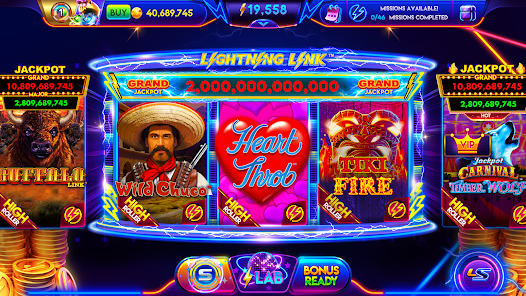
Every Lightning Link machine displays four jackpots:
- MINI — fixed by denomination
- MINOR — fixed by denomination
- MAJOR — local progressive
- GRAND — linked progressive across the bank
The MINI and MINOR are constant per denomination. The MAJOR grows independently. The GRAND is shared across a bank of machines.
But the real architectural trick is not the jackpot amounts. It is how they are earned. The only way to win the GRAND is to fill all 15 positions in the Hold & Spin grid.
Which means: you never “hit” the GRAND. You progress into it.
Hold & Spin: The Core Engine
The Hold & Spin bonus is triggered when enough Lightning symbols land.
Once triggered:
- You receive three spins.
- Each new symbol locks into the grid.
- Each new symbol resets the spin counter.
- The bonus ends only when no new symbol lands.
Every symbol carries a hidden value. You do not know what it will be until it locks.
This creates three simultaneous tension layers:
- Spatial tension — will you fill one more square?
- Temporal tension — will you reset the spins again?
- Value tension — what will the next symbol be worth?
6) Free Games: Modular Bonus Variants
While Hold & Spin and jackpots are structurally consistent across Lightning Link games, Free Games are modular.
| Game | Scatter Symbol | Free Games | Feature |
|---|---|---|---|
| Bengal Treasures | Taj Mahal | 8 | Doors Reveal |
| Wild Chuko | Swag Bags | 8 | Doors Reveal |
| Tiki Fire | Volcano | 6 | Multiplying Symbols |
| Heart Throb | Moons | 6 | Multiplying Symbols |
| Moon Race | Moon Race | 10 | Remove low symbols |
| Best Bet | Horseshoe | 10 | Remove low symbols |
| Magic Pearl | Dolphins | 6 | Large central symbol |
| High Stakes | Briefcase | 6 | Large central symbol |
| Dragon Riches | Dragon Orb | 6 | Expanding Wilds |
| Eyes of Fortune | Lanterns | 6 | Expanding Wilds |
| Sahara Gold | Palace | Choice | Two mystery features |
| Happy Lantern | Dragon | Choice | Two mystery features |
All Free Games:
- Are triggered by three scatters
- Can be retriggered
- Can trigger Hold & Spin during Free Games
This creates a nested bonus architecture: bonus inside bonus, progression inside progression.
7) Why This Architecture Spread Everywhere
Once Lightning Link proved this structure worked, the industry copied it endlessly.
Today’s Hold & Spin families — Dragon Link, Cash Link, Fire Link, Buffalo Link, Zeus Link — all inherit the same skeleton:
- Grid bonus
- Locked symbols
- Resetting spins
- Progressive ladder
- Fullgrid jackpot
They are not clones. They are descendants.
8) Parallel: Collector-Driven Bonus Slots
The Lightning Link architecture is not isolated. It is the land-based ancestor of a broader online pattern:
- Mayan Moons
- Gladiator (Betsoft)
- Moon Goddess
- Mayan Riches
- Kitty Glitter
- Siberian Storm
- Golden Goddess
- Thunderstruck II
In all of them, the base game is structurally subordinated to a collector or progression-driven bonus.
The spin is no longer the unit of meaning. The bonus state is.
Final Thought: When the Bonus Became the Game
Lightning Link did not become dominant because of jackpots. It became dominant because it redefined what a slot is allowed to be.
It turned a slot from:
A machine that pays sometimes
into:
A machine that feels like it is almost paying all the time
And architecturally, that illusion is far more powerful than raw volatility.