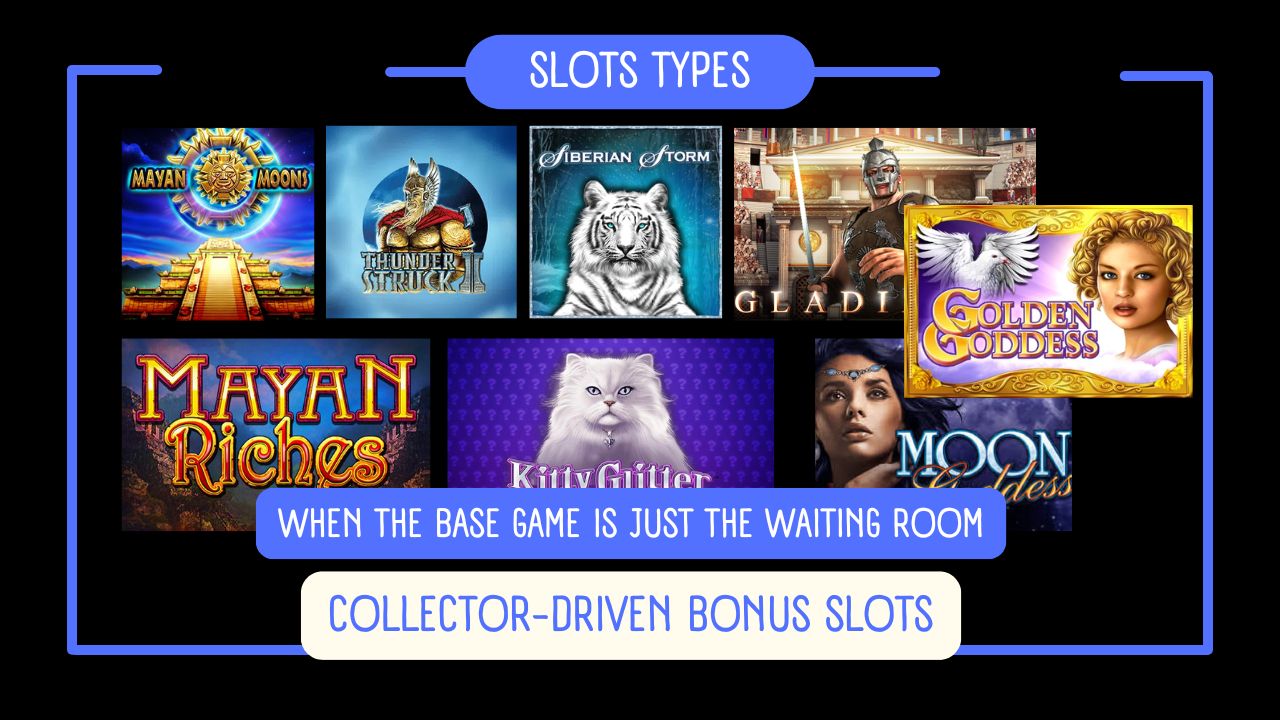
Collector-Driven Bonus Slots: When the Base Game Is Just the Waiting Room
There is a quiet but powerful architecture running through a subset of modern and legacy slots — one that flips the usual logic of “spin → win → bonus” on its head. In these games, the base game is not where the story happens. It is where the story waits.
Instead of delivering excitement directly, the base game behaves like a staging area. Symbols appear not to pay, but to prepare. Progress meters fill. Wilds accumulate. Multipliers are banked. States are unlocked. And only when enough invisible structure has been built does the slot finally allow a meaningful release of value.
What defines the collector-driven architecture?
- Stateful bonuses. Something persists across spins — unlocked wilds, collected symbols, progress tiers, or bonus stages.
- Deferred value. Early bonus actions rarely pay much by themselves; they exist to amplify what comes later.
- Conditional explosion. Real volatility is only released if the internal machine lines up just right.
- Psychological gravity. Once progress is visible, players feel compelled to stay until the structure resolves.
Why these specific slots belong to the same architecture
Mayan Moons (Novomatic)
Mayan Moons introduces the template: a bonus that mutates itself mid-flight. The eclipse moon does not pay immediately. It waits for amulets. Each amulet strengthens the final resolution.
→ Read the Slot’s above-the-fold summary for Mayan Moons
Gladiator (Betsoft)
Gladiator fragments its value across multiple micro-features: expanding wild reels, queen wild spreads, and the Gladiator Battle. Each feature alone feels underpowered. Together they form a slow-burn pressure system.
→ Read the Slot’s above-the-fold summary for Gladiator
Moon Goddess (Bally)
Moon Goddess formalizes deferred structure. The wheel bonus does not simply pay. It chooses a future. Full moons accumulate. Only on the final spin does the slot cash in its internal ledger.
→ Read the Slot’s above-the-fold summary for Moon Goddess
Mayan Riches (IGT)
Mayan Riches modernizes the same DNA: a calm base game, infrequent triggers, and a bonus phase that behaves like a pressure valve. The base game withholds energy. The bonus releases it.
→ Read the Slot’s above-the-fold summary for Mayan Riches
Extended architecture: modern collector implementations
Kitty Glitter (IGT)
The free spins are not the prize. They are the workbench. Diamonds on reel five unlock wild cats. Every three diamonds permanently changes the bonus state. Only once enough cats are converted does volatility finally appear.
→ Read the Slot’s above-the-fold summary for Kitty Glitter
Siberian Storm (IGT)
Tiger Eyes do not simply trigger free spins. They stack. They chain. They can generate multiple bonus sets from a single screen. Here, collection happens spatially rather than symbolically.
→ Read the Slot’s above-the-fold summary for Siberian Storm
Golden Goddess (IGT)
Golden Goddess transforms the collector idea into stacked-symbol economics. Before every spin, one symbol is secretly chosen to dominate a reel. Free spins let you lock which symbol becomes super-stacked.
→ Read the Slot’s above-the-fold summary for Golden Goddess
Thunderstruck II (Microgaming)
Thunderstruck II is a progression collector disguised as a traditional bonus slot. Each hammer does not pay. It advances you through a bonus ladder. Earlier bonuses exist mainly to unlock later, more volatile ones.
→ Read the Slot’s above-the-fold summary for Thunderstruck II
How to spot this architecture in new slots
- Persistent meters or unlock states that carry across spins or across bonus rounds.
- Bonuses that modify future bonuses rather than paying immediately.
- Symbol collection mechanics where symbols exist primarily to change future behavior.
- Final-spin resolution logic where accumulated value is paid all at once.
- Multiple bonus tiers where early bonuses mainly exist to unlock later ones.
If the base game feels deliberately underpowered — and the bonus feels suspiciously overloaded — you are probably looking at a collector architecture.
Why this architecture exists at all
Collector-driven slots solve a design contradiction: how to keep players engaged during long low-volatility stretches without paying too much.
They replace frequent payouts with visible progress. They substitute cash feedback with structural feedback.
Instead of: “I won 2× my bet.” They offer: “I unlocked something that could be worth 200× later.”
And that is why, in these slots, the base game is not the game. It is the waiting room.